The GAFEDP Legislation & The Loophole That Failed Kaye Gray
Guardianship Abuse · Financial Exploitation · Denial of Due Process
"The law exists. The court had the power to act. It chose not to."
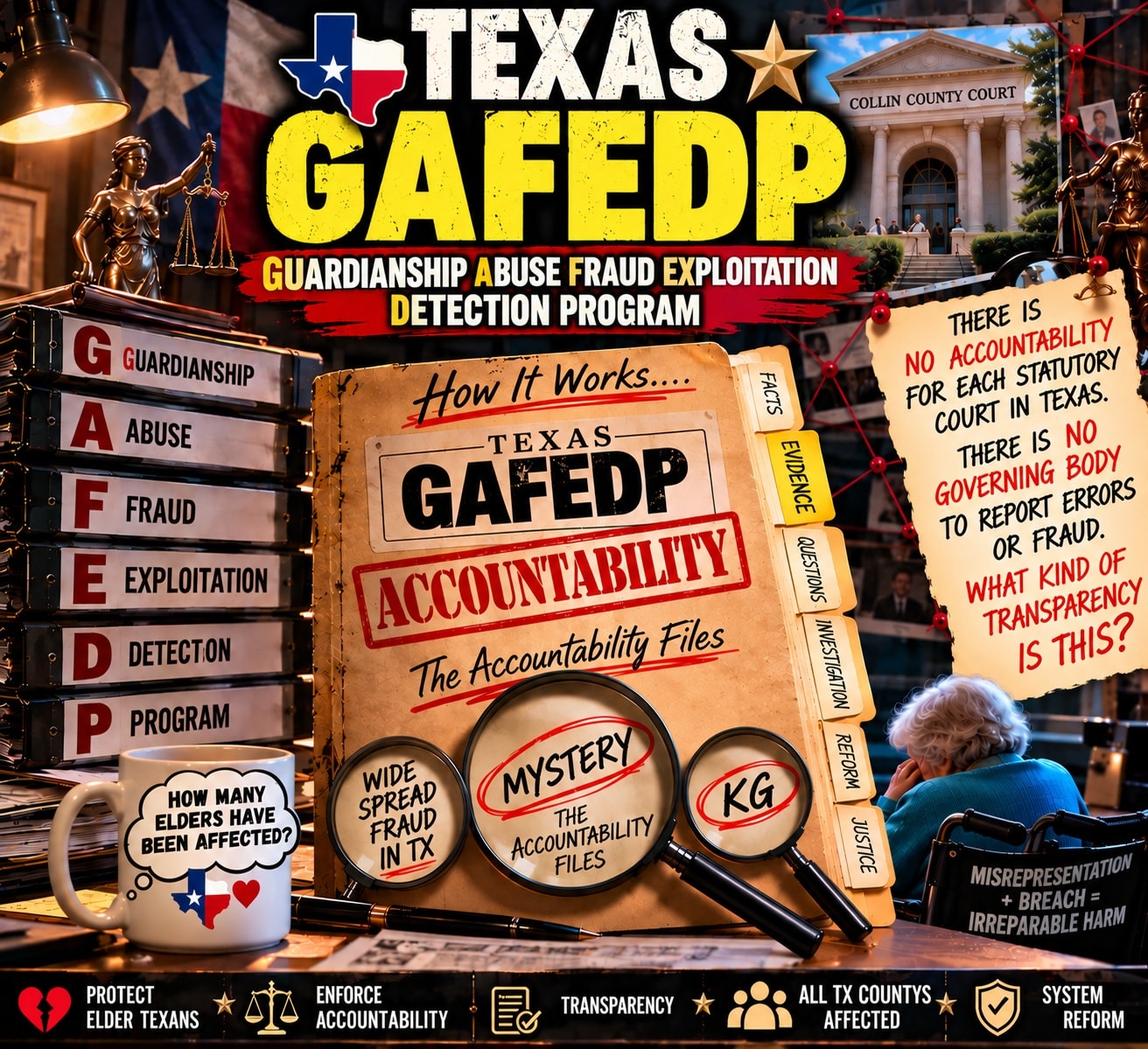
Texas created the Guardianship Abuse, Fraud, and Exploitation Deterrence Program — GAFEDP — to detect and investigate abuse, fraud, and exploitation inside guardianship cases. The legislation was a step forward. But it contains a critical loophole that left Kaye Gray completely unprotected.
What Does GAFEDP Stand For?
Guardianship
The program targets abuse occurring inside court-ordered guardianship arrangements — where a vulnerable adult's rights and assets are placed under another person's legal control.
Abuse
Physical, emotional, and psychological abuse of wards under guardianship — the harm GAFEDP was specifically designed to detect, investigate, and stop.
Fraud
Fraudulent conduct by guardians, attorneys, and court-appointed parties — including false medical diagnoses used to justify or extend a guardianship against a ward's will.
Exploitation
Financial exploitation of a ward's estate, assets, and resources by those entrusted with their care — one of the most common and devastating forms of guardianship abuse.
Deterrence
The program's stated purpose: to deter abuse, fraud, and exploitation through oversight, investigation, and accountability. A purpose the loophole renders unenforceable.
Program
A Texas legislative program with real authority — but fatally undermined by the absence of any independent oversight over the statutory court responsible for initiating its use.
The Loophole That Failed Kaye Gray
The GAFEDP legislation contains a fundamental structural flaw: there is no independent oversight of the statutory probate court that is itself responsible for conducting or requesting the audit. The court that may be complicit in the failure is also the court with sole authority to initiate the review. No external body is empowered to compel the court to act. No mechanism exists to check whether the court performed its duty — or deliberately chose not to.
No Oversight of the Court Performing the Audit
GAFEDP places audit authority with the statutory probate court. But the legislation provides no independent oversight body to verify that the court actually conducted a review, acted on findings, or fulfilled its obligations to the ward. The court is accountable to no one.
No Checks on Whether the Court Requested Assistance
The court had the explicit authority to request GAFEDP assistance to investigate and review Kaye Gray's guardianship for fraud, abuse, and exploitation. It never did. There is no requirement that it explain why. There is no penalty for inaction. The legislation created a tool the court was free to ignore.
No Medical Audit Was Ever Initiated
A medical audit of Kaye Gray's guardianship was never initiated — despite documented evidence of a false bipolar and schizophrenia diagnosis by a doctor who is now incarcerated, and despite years of reported concerns. The court could have requested GAFEDP involvement at any time. It did not.
The Legislation Requires Emergency Amendment
Until the legislature closes this loophole — by creating an independent oversight mechanism with authority over the statutory court itself — GAFEDP cannot fulfill its purpose. Courts that fail to act face no consequence. Wards like Kaye Gray remain unprotected.
The GAFEDP legislation was meant to protect people like Kaye Gray. Instead, a structural loophole allowed the very court responsible for oversight to do nothing — with no accountability, no penalty, and no review. That loophole must be closed. Emergency amendments to the legislation are required now.
Read Kaye's Full Story→